Shortlister is a favorite resource for BSDI’s leadership, and we love engaging with their content. There is one report, in particular, that we feel hasn’t gotten enough attention since it was released last year. The Wellness Trends 2021 report isn’t just a useful reference for program vendors like BSDI, but a valuable resource for health promotion program managers!
The report consolidates and analyzes data from 125 top benefits consultants and documents many of the sweeping changes that the COVID pandemic brought to the wellness industry.
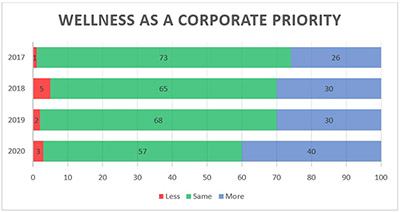
The first, and best, news is that health promotion professionals remain in a commanding position as corporate health promotion continues to grow. Across all organization types, the number of respondents indicating that organizations had increased the priority of workplace wellbeing programs went from 26% in 2017 to 40% in 2020.
The percentage of people reporting a decline in priority is consistently in the low, single digits. Combined with the additional data described below, this indicates a very strong commitment to program implementation as a core value.
This consistent growth in expectations demonstrates that wellness and health promotion remain highly attractive as a corporate strategy.
The Changing Focus of Corporate Wellness Programming
BSDI introduced a slew of remote programming options, including virtual check-ins & Les Mills videos, in response to the changes wrought by the COVID pandemic. Just as we noticed a pronounced shift in interest from on-site services to online services, Shortlister documents a significant shift in program components away from services like biometric tracking and health risk assessments and toward mental and behavioral health and comprehensive wellness platform programming. Financial wellness and caregiving services also saw a significant increase. As a leading advocate for comprehensive wellness program, BSDI is obviously happy with this shift. We provide a range of “Interactive Learning Programs” suitable for remote engagement, including financial wellness, so we can help our clients with those as well.
Shortlister also documents a significant decline in Onsite Fitness programs, which we felt as well. Many folks don’t realize that, with our fitness heritage, BSDI still provides dozens of fitness-focused portals. While 2020 and early 2021 did see a significant decline in these programs, we are pleased to report that onsite fitness appears to be making a real rebound, although almost always with a strong virtual component as well.
Creating a Wellness Hub
In a continuation of previous trends, benefits consultants observed that reliance on carrier wellness programs (those provided by insurance) continues to decline in favor of comprehensive portals that blend wellness with other benefits programs.
The importance of this for your program is straightforward: to the extent possible, you need to address the wholistic needs of your wellness program participants. The days of simply doing some biometrics and perhaps a team challenge appear to be behind us. While both may be quite valuable, they play a role in a broader, more comprehensive approach to wellness and wellbeing.
In keeping with this trend, Shortlister also documents a significant decline in interest in outcomes-based programs. Interestingly, this is combined with a massive shift toward programs that make use of claims data to address employee needs. While these two may seem contradictory (“do we need hard measures of health or not?”), they really aren’t: pulling hard data across your whole population to predict future health issues is nowhere near as relevant to costs as pulling that data for people already suffering from health challenges. Our experience with claims data integration reflects this reality. Organizations able to find participants in greatest needs – and who suffer the greatest costs – can use our tools and technology to provide focused, high-quality benefits. This need take nothing away from the broader program implementation, it just provides a more straight-forward path to real returns on your effort.
Program Focus
The remainder of the Shortlister report captures obstacles to health promotion and, in greater detail, program investment trends. The biggest obstacle lies in creating an internal communications strategy while the obstacles with the least impact are technology complexity and logins. This is reflected in our evolution as well. BSDI has significantly enhanced our communications tools every year for the past four with new options, new analytics, and new templates. This continues to be an area of focus for us because we recognize the importance (and challenge) of an effective comms strategy.
Program investment trends are similar to the take-away above. Behavior health, EAPs, telehealth, care-giving assistance, and, to a lesser extent, DEI initiatives all saw significant additional funding. Biometric programming saw a significant drop in investment, while women’s health, fitness/weight management, and tobacco cessation saw a relatively steady level of investment.
The New Normal
The challenges of the COVID pandemic and the nearly instant shift to remote work presented great challenges, but great opportunities as well, to the health promotion community. Corporate wellness programs and professional have needed to quickly adapt to this new normal. While we do see indications that some things are "returning to normal” (ex., rising number of on-site fitness offerings), many of the changes spawned by COVID appear to be permanent. Behavioral health, comprehensive wellness programming, EAP integration, increased interest in DEI, and remote and virtual offerings all appear to be well-established, and likely permanent, features of the corporate wellness landscape.